


5 Types of Medical Coding That Support Healthcare
5 Types of Medical Coding That Support Healthcare
The profession of medical coding is vital to the healthcare delivery system through the conversion of complicated health care records into approved standardized codes used in billing, insurance claims, and research data. As the healthcare system continues to expand, the need for skilled medical coders continues to evolve, with coders and other healthcare professionals now required to capture data beyond billing codes. It’s important to know about the many types of medical coding since the different types of codes offer unique contributions to efficiency and documentation accuracy.
These types of medical coding also work together in various ways to manage revenue effectively. This web journal outlines the fundamental types of medical coding, their impact on reporting healthcare service delivery, and the financial processes inherent to revenue cycle management. For those aspiring to build a successful career in this field, choosing the right medical coding institute in Kerala is essential to gain the knowledge and skills required for excellence in healthcare documentation and coding.
What is Medical Coding?
Medical coding is the transformation of the various complicated healthcare diagnoses, clinical procedures, medical services, and other relevant information into standardized alpha-numeric codes. These codes reflect diagnostic information, medical services and treatments provided to the patient. While coding, coders extract information and subsequently code from major operative reports, performance notes and results from lab and radiology reports, and discharge summaries. Medical coding ensures proper billing of the service provided which encourages smoother billing transactions for third-party insurance providers, as well as keeping health records consistent throughout the healthcare delivery system.
Medical coding also allows for improved analytics, and quality reporting, and helps support research. By changing a narrative report into standardized codes, medical coders create valuable information that contributes to the financial and operational success of healthcare delivery systems.
Main Types of Medical Coding
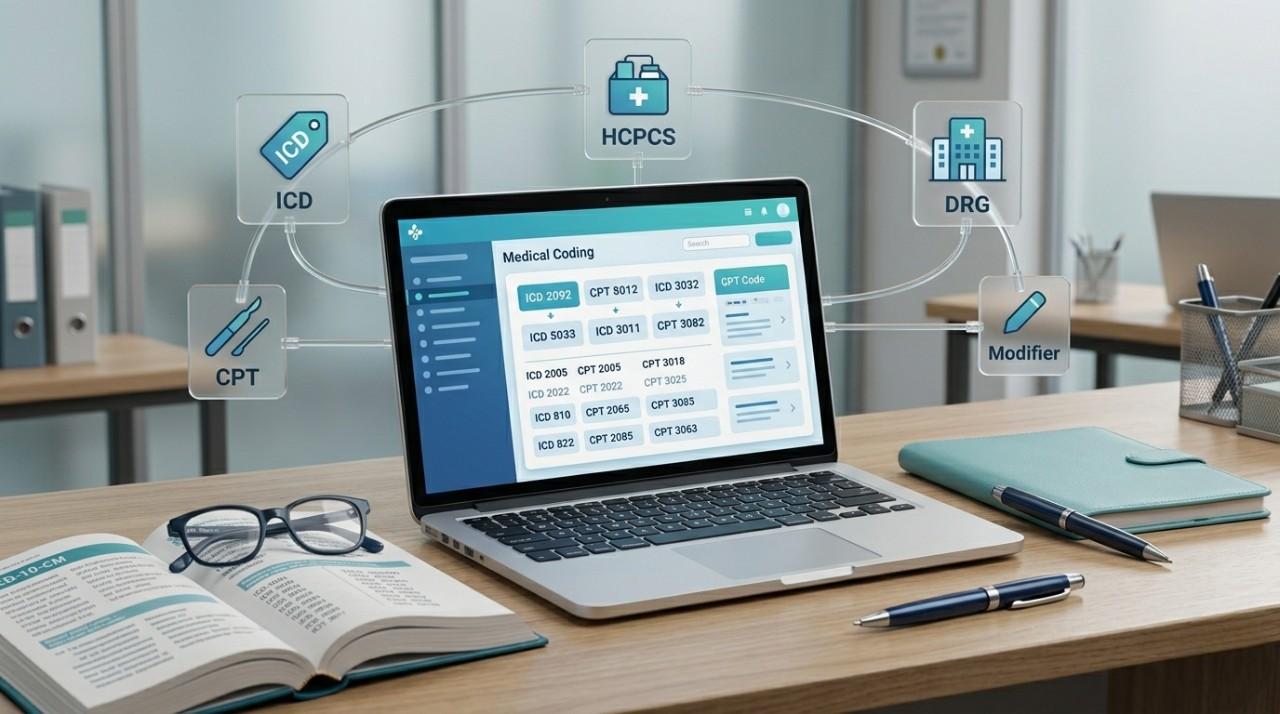
Medical coding is an activity of converting complex medical information into codes for diagnoses, procedures, and treatments. These codes are utilized for billing, patient records, and insurance purposes. An understanding of the types of medical coding is necessary to enter the field or improve healthcare documentation. Five main types of medical coding:
ICD Codes – For Diagnoses
ICD means International Classification of Diseases. ICD codes refer to diseases, injuries, and types of health conditions. Created by the World Health Organization (WHO), they provide the very specific diagnosis the patient received and provide clarity for the hospital and insurance companies.CPT Codes – For Procedures
The Current Procedural Terminology Core Process (CPT) codes signify each treatment or procedure performed on a patient, such as check-up, surgery, lab test procedures, etc. CPT codes are more for doctors and clinics for billing Medicare and insurance.HCPCS Codes – For Services and Supplies
Healthcare Common Procedure Coding System (HCPCS) codes are used in procedures, wheelchairs, medicines, ambulances etc. which are not addressed by the current CPT codes.DRG Codes – For Hospital Billing
DRG stands for Diagnosis-Related Groups. DRG codes are primarily used to pay hospitals for patient stays.Modifiers – Extra Details about a Service
Modifiers are short codes that can be added to CPT or HCPCS codes to communicate more information like whether a procedure was repeated or if there were slight variations from the procedure that is normally performed.
What Education Supports the Medical Coding Course Qualification?
If you are going to be a medical coder, you will need to prepare yourself to meet the requirements of the medical coding course in the program place of your choice. Medical coding course requirements typically include:
- Ability to demonstrate attention to details and analytical skills
- English speaking and basic computer programming
- Completion of a certified medical coding training course
Most certified courses will give details in the course modules on some or all of the body systems, ICD, and CPT system of coding regulations, and actual clinical training.
Scope of Medical Coding: Why it’s a Developing Career Field
The field of medical coding is expanding quickly, both in India and the world. With the transition toward digitizing health records, and an influx of insurance penetration, there is high demand for trained coders in hospitals, BPOs, insurance companies, ridership companies and nearly all government agencies involved in health. Benefits include:
- High job demand in both domestic and international markets
- Attractive salary packages with career growth potential
- Openings to work remotely or as a specialist
- Entry into the healthcare sector without a medical degree
Conclusion
If you are looking to work in a hospital, medical billing company, or even a healthcare BPO that does business globally, learning and understanding the different types of medical coding will help you get started. The scope of medical coding is expanding quickly, with high demand in the field, great job prospects, and the opportunity for international mobility and job opportunities, pursuing a career in medical coding is a smart choice.
If you are ready to develop your skills and obtain certification, then review our medical coding course in Kerala – your healthcare career starts here.
Ibis is accredited by the IACET (International Accreditors for Continuing Education and Training) and offers IACET CEUs for its learning events that comply with the ANSI/IACET Continuing Education and Training Standard. This prestigious accreditation underscores the quality and global acceptance of the education provided at Ibis.




.webp)